
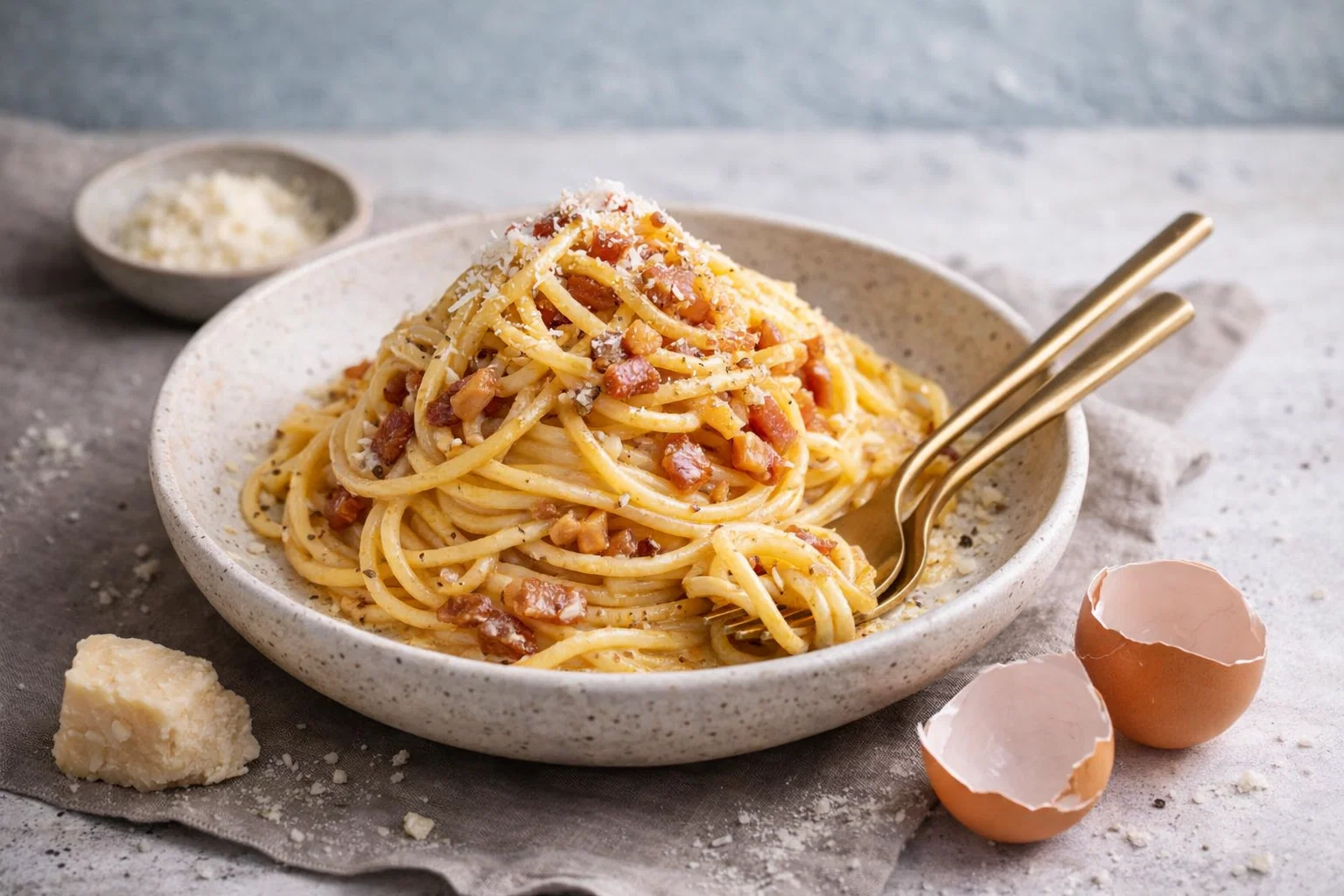
Authentic Carbonara Recipe
Table of Contents
This authentic carbonara recipe is made the traditional Italian way — no cream, no shortcuts, just guanciale, eggs, Pecorino Romano, Parmigiano Reggiano, and the emulsification technique that transforms pasta water into a silky, luxurious sauce in 15 minutes.
Thank you for reading this post, don't forget to subscribe!I. The No-Cream Manifesto: What Real Carbonara Actually Is
Let us address the elephant in the room immediately, directly, and without apology: authentic carbonara does not contain cream. Not a splash. Not a tablespoon. Not a small amount just to make it easier. No cream. None. Ever.
This is not culinary snobbery for its own sake. This is the difference between a fundamentally different dish and the real thing — the authentic carbonara recipe that has been made in Rome for generations using nothing more than eggs, aged cheese, cured pork, black pepper, and pasta. The creaminess comes from an emulsification of egg yolks, rendered fat, and starchy pasta water. It is a technique, not an ingredient. And the result it produces is categorically different — in flavor, in texture, and in the way it sits on your palate — from anything that cream can replicate.
Why Adding Cream Is Considered Cheating
The argument against cream in carbonara is not arbitrary. It is structural. Cream adds dairy fat — a heavy, coating fat that leaves a slick residue on the inside of your mouth and mutes the sharper, more complex flavors of the guanciale and aged cheese. It makes the sauce thicker in a blunt, one-dimensional way that requires no skill. And it entirely bypasses the extraordinary emulsification technique that is the soul of this dish — the magical transformation of a watery liquid into a sauce that clings to every strand of spaghetti in a way that cream simply cannot achieve.
Adding cream to carbonara produces a perfectly fine pasta dish. It does not produce an authentic carbonara recipe. The distinction matters because what you get from the real technique — from the properly executed emulsion of yolks, guanciale fat, and pasta water — is richer, more complex, and more genuinely satisfying than the cream version, without the heavy dairy fat coating that makes cream-based sauces feel indulgent in a slightly uncomfortable way.
The Win-Win Result: Rich and Creamy Without the Heavy Dairy Slick
The best possible outcome of making this authentic carbonara recipe correctly for the first time is the realization that you were not giving anything up by omitting the cream — you were gaining something. The egg and cheese emulsion delivers a rich, deeply savory creaminess that coats the pasta silkily without the heavy, slightly greasy mouthfeel that full-fat cream leaves behind. It is a pasta fix that satisfies the craving completely, feels genuinely luxurious, and leaves you feeling pleasantly full rather than weighted down.
This is why the no-cream position is not about restriction. It is about access to a better result.
II. The Four Pillars: Essential Ingredients for Authentic Carbonara
The authentic carbonara recipe stands on four essential components. Understand what each one does and why it cannot be casually replaced, and you will understand the dish itself.
Pillar One: Guanciale — The Gold of Carbonara
Guanciale is cured pork cheek — not bacon, not pancetta, but the specific cut of Italian cured pork that provides the essential fat matrix the carbonara sauce depends upon. Guanciale has a higher fat content than either bacon or pancetta and a more delicate, nuanced pork flavor — sweeter and more subtle than the smokiness of bacon — that does not compete with the aged cheese and egg yolks but instead complements them.
The fat rendered from guanciale is not merely a cooking medium in this authentic carbonara recipe — it is a primary structural ingredient in the sauce itself. When the rendered guanciale fat combines with the starchy pasta water and the egg yolk mixture, it creates the emulsion that gives carbonara its characteristic silky texture. The fat molecules encapsulate the water molecules and distribute the egg proteins evenly through the sauce, producing a consistency that is simultaneously light and rich in a way that only a properly constructed emulsion can achieve.
When you cut guanciale into thick batons rather than thin slices, two things happen: the exterior develops a satisfying golden crust during sautéing while the interior remains tender and yielding, and each piece provides a genuinely meaty, texturally interesting element in the finished bowl. Thin-cut guanciale renders down to near-nothing and loses the textural contribution that makes each bite of great carbonara punctuated by moments of rich, custardy pork.
Pillar Two: The Cheese — Grate It Yourself
The authentic cheese choices for this authentic carbonara recipe are Parmigiano Reggiano, Pecorino Romano, or a blend of both. Either works. The traditional Roman version leans toward Pecorino Romano — sharper, saltier, and more assertively flavored than Parmigiano Reggiano, with a more pronounced tang that cuts through the richness of the egg yolks. A blend of both delivers the depth of Parmigiano with the sharpness of Pecorino in a balance that many cooks find ideal.
Grate your own cheese at the moment you need it. This is not optional in the context of this recipe. Pre-grated cheese sold in bags or tubs is coated with anti-caking agents — typically cellulose — that prevent the cheese from clumping in the packaging. These same agents prevent the cheese from melting smoothly into the egg and pasta water emulsion, producing a grainy, separated result rather than the silky, smooth sauce that freshly grated cheese creates. The 90 seconds it takes to grate Pecorino or Parmigiano fresh is one of the most impactful 90 seconds you will spend in the kitchen.
Grate as finely as possible — a microplane or the finest side of a box grater produces the best result. Finely grated cheese incorporates more completely and rapidly into the warm emulsion than coarsely shredded.
Pillar Three: The Egg Ratio — Whole Eggs Plus Extra Yolks
The egg composition for this authentic carbonara recipe is deliberately specific: whole eggs combined with additional egg yolks. The whole eggs provide structure and protein; the extra yolks provide the fat and lecithin that make the sauce extraordinarily rich and stable. More yolks means more richness, better emulsification, and a deeper golden color in the finished sauce.
The precise ratio varies slightly between Italian cooks and regions — some use one whole egg plus three yolks for two portions, others use more whole eggs with fewer additional yolks. The principle is consistent: always use more yolks than whole eggs, and always use more eggs than you initially think you need. The result should be what can only be described as off-the-charts richness — a sauce so deeply custardy and golden that it seems impossible it was created without cream.
Pillar Four: Pasta Water — The Magic Ingredient
Starchy pasta water is the ingredient that makes the emulsification of this authentic carbonara recipe possible — the liquid medium that, when combined with the rendered guanciale fat and the egg yolk mixture, transforms from a cloudy, unremarkable liquid into a luxurious, silky sauce that clings to every strand of pasta.
The starch released into the cooking water as pasta boils is the key. It acts as an emulsifier — a molecule with one end that bonds with fat and another that bonds with water — that holds the fat and water components of the sauce in a stable suspension rather than allowing them to separate. More starch in the water means a more stable, more luxurious emulsion. This is why the pasta water must be pasta cooking water — starchy from the pasta itself — and not plain hot water, which contains no starch and cannot create the same effect.
Reserve at least one full cup of pasta water before draining. You will likely not use all of it, but having it available allows you to adjust the sauce consistency precisely as you build the emulsion.
III. Pro Technique: Mastering the Emulsification
The Magic Transformation: What You Are Aiming For
The central technique of this authentic carbonara recipe is the controlled transformation of three separate components — rendered guanciale fat, egg and cheese mixture, and starchy pasta water — into a single, unified, silky sauce that coats every strand of pasta completely and evenly. This transformation is an emulsification: the conversion of fat and water into a stable, creamy, homogeneous sauce.
When it works correctly, the sauce goes from visibly separate components to a glossy, cohesive coating that clings to the pasta with a consistency somewhere between a thin custard and a very loose cream sauce. It is thicker than you expect, lighter than cream, and more deeply flavored than either component alone. The pasta does not sit in a pool of sauce — the sauce adheres to the pasta, coating each strand individually.
The Wooden Spoon Handle Technique
The most effective mixing technique for building the emulsion in this authentic carbonara recipe uses an unexpected tool: the handle of a wooden spoon. Rather than stirring gently with the spoon end, grip the spoon at the head and use the handle to stir the pasta and sauce mixture in a vigorous, fast, circular motion. The handle provides a more direct, less resistive mixing surface that creates faster movement through the pasta and generates more consistent contact between the sauce components.
The goal is vigorous, continuous motion — not gentle folding. The emulsion forms through mechanical agitation combined with the residual heat of the pasta. More movement means faster emulsification and a smoother, more cohesive finished sauce.
Heat Management: The Most Important Safety Rule
The single greatest technical risk in making this authentic carbonara recipe is scrambled eggs — the result of exposing the egg yolk mixture to direct, intense heat before the emulsion has formed. Once the eggs scramble, the sauce is unrecoverable. Scrambled carbonara is a textural disaster that no amount of pasta water or cheese can rescue.
Prevent this with absolute certainty by following one rule: mix the pasta and sauce in a large bowl off the stove, away from any direct heat source. The residual heat in the pasta and the rendered guanciale fat is sufficient — indeed, it is the correct temperature — to cook the eggs gently and evenly as the emulsion forms. Direct stove heat is excessive and uncontrollable at this scale. Remove the pan from the heat entirely, transfer the pasta to a warmed mixing bowl, and work there.
If the sauce becomes too thick as it cools, add a splash of warm pasta water and toss vigorously to loosen. If it seems too thin, continue tossing — the emulsion will tighten as it cools slightly.
IV. The 15-Minute Execution: Step-by-Step
Preparation: Cutting the Guanciale
Cut approximately 150 to 200 grams of guanciale into thick batons — pieces approximately 1 cm thick and 3 to 4 cm long. The thickness ensures a satisfying golden crust on the exterior during sautéing while preserving a tender, yielding interior. This is the cut that produces the characteristic textural contrast in each bite of great carbonara.
While the guanciale is being prepared, bring a large pot of well-salted water to a rolling boil. The salting of the pasta water matters significantly here — it is one of the few opportunities to season the pasta itself.
Sautéing: Rendering the Guanciale in Its Own Fat
Place the guanciale batons in a cold skillet — no oil, no butter, no added fat of any kind. Starting in a cold pan allows the fat to render slowly and completely from the interior of the guanciale before the exterior begins to brown, producing a maximum yield of rendered fat and ensuring the meat itself is cooked through before the exterior crisps.
Increase heat to medium and cook, turning occasionally, until the guanciale is deeply golden on all exterior surfaces and the fat has rendered into the pan as a clear, aromatic cooking liquid. This takes approximately 5 to 7 minutes. Remove from heat and set aside — do not discard a single drop of the rendered fat.
The Egg and Cheese Mixture: Whisk Until Smooth
In a large bowl — larger than you think you need, as the pasta will be added here — whisk together the eggs, additional yolks, and finely grated cheese until completely smooth and homogeneous. Season generously with freshly cracked black pepper. Set this bowl aside near the stove but not on it.
Integration: Building the Authentic Carbonara Sauce
When the pasta is al dente — cooked to the point of tenderness with a clear bite remaining at the center — reserve one full cup of the pasta cooking water before draining. Drain the pasta and add it immediately to the pan with the guanciale and rendered fat. Toss vigorously over low heat for 30 seconds, ensuring every strand of pasta is coated in the guanciale fat. This fat coating is what prevents the eggs from scrambling when the pasta is transferred to the egg mixture.
Remove the pan from heat entirely. Transfer the fat-coated pasta and guanciale into the large bowl with the egg and cheese mixture. Add a generous splash of the reserved pasta water — start with approximately ¼ cup. Using the handle of a wooden spoon, toss and stir vigorously and continuously, adding pasta water splash by splash until the sauce reaches a glossy, silky consistency that coats every strand of the authentic carbonara recipe. Serve immediately.
V. The Golden Rule of Serving: Pasta Waits for No One
Immediacy Is Not Optional
This is perhaps the most important rule of serving an authentic carbonara recipe: pasta waits for no one. The carbonara sauce is at its peak — its most silky, its most cohesive, its most deeply flavored — in the first two to three minutes after plating. As it sits, the emulsion begins to tighten, the pasta continues to absorb the sauce, and the extraordinary texture that was present immediately after plating becomes progressively less spectacular.
Call everyone to the table before the pasta goes in the water. Have the bowls ready. Have the additional pepper and cheese ready. The moment the carbonara is plated, it needs to be eaten. Any other approach is a compromise.
Warm Bowls: Extending the Perfect Texture
The most practical technique for extending the silky, slick, juicy quality of the carbonara sauce after plating is serving in pre-warmed bowls. Cold ceramic immediately begins pulling heat from the sauce, accelerating the tightening of the emulsion and the thickening of the texture. Warm bowls — heated by filling with boiling water for one minute and then drying quickly before plating — maintain the sauce at its ideal serving temperature for significantly longer, allowing each person at the table to eat the authentic carbonara recipe at its best rather than racing against the cooling process.
VI. Economical Substitutions: When Guanciale Is Not Available
Bacon and Pancetta: Very Respectable Alternatives
The unavailability of guanciale is not a reason to abandon this authentic carbonara recipe — it is a reason to use the next best available option with appropriate technique adjustments.
Pancetta — Italian cured pork belly — is the closest substitute and produces an excellent carbonara with a slightly different but equally legitimate flavor profile. Its fat content is adequate for the sauce emulsification, its flavor is more neutral than guanciale but still authentically Italian, and it is available in most supermarkets with a reasonable specialty cheese section.
Streaky bacon — regular smoked bacon, unsmoked if possible — can produce a genuinely very respectable version of this authentic carbonara recipe that, while technically different from the Roman original, captures the spirit of the dish in a way that should make any Italian home cook nod with qualified approval. The smokiness adds a dimension that is not traditional but is not unpleasant. The fat renders adequately for the emulsification.
The Non-Negotiable: Choose Streaky, Never Lean
Regardless of which pork product you use as a guanciale substitute in this authentic carbonara recipe, it must be streaky — meaning it must have significant fat running through it. The fat is not a textural feature of the dish. It is a structural ingredient in the sauce. A lean pork product — lean ham, turkey bacon, or lean pancetta — does not render enough fat to create the emulsion. The result will be a dry, under-sauced carbonara that no amount of pasta water or additional cheese can rescue.
When you look at your chosen cut of pork, you should see visible veins of fat running through the meat before you begin. If you do not see fat, choose a different cut.
VII. Authentic Carbonara Recipe Card
Prep Time: 5 minutes Cook Time: 15 minutes Total Time: 20 minutes Yield: 4 servings
Ingredients
The Pasta:
- 400g (14 oz) spaghetti or rigatoni
- Large pot of well-salted boiling water
- 1 cup pasta cooking water, reserved

The Pork:
- 150–200g (5–7 oz) guanciale, cut into
  thick batons
  (substitute: pancetta or streaky bacon —
  must be high-fat/streaky)

The Egg Mixture:
- 2 large whole eggs
- 4 large egg yolks (extra yolks = extra richness)
- 80g (3 oz) Pecorino Romano, finely grated
  (or Parmigiano Reggiano, or a blend of both)
- Generous amount of freshly cracked
  black pepper

Notes:
- No cream — ever
- No oil for sautéing guanciale —
  it renders in its own fat
- Freshly grated cheese only —
  no pre-shredded or powdered varieties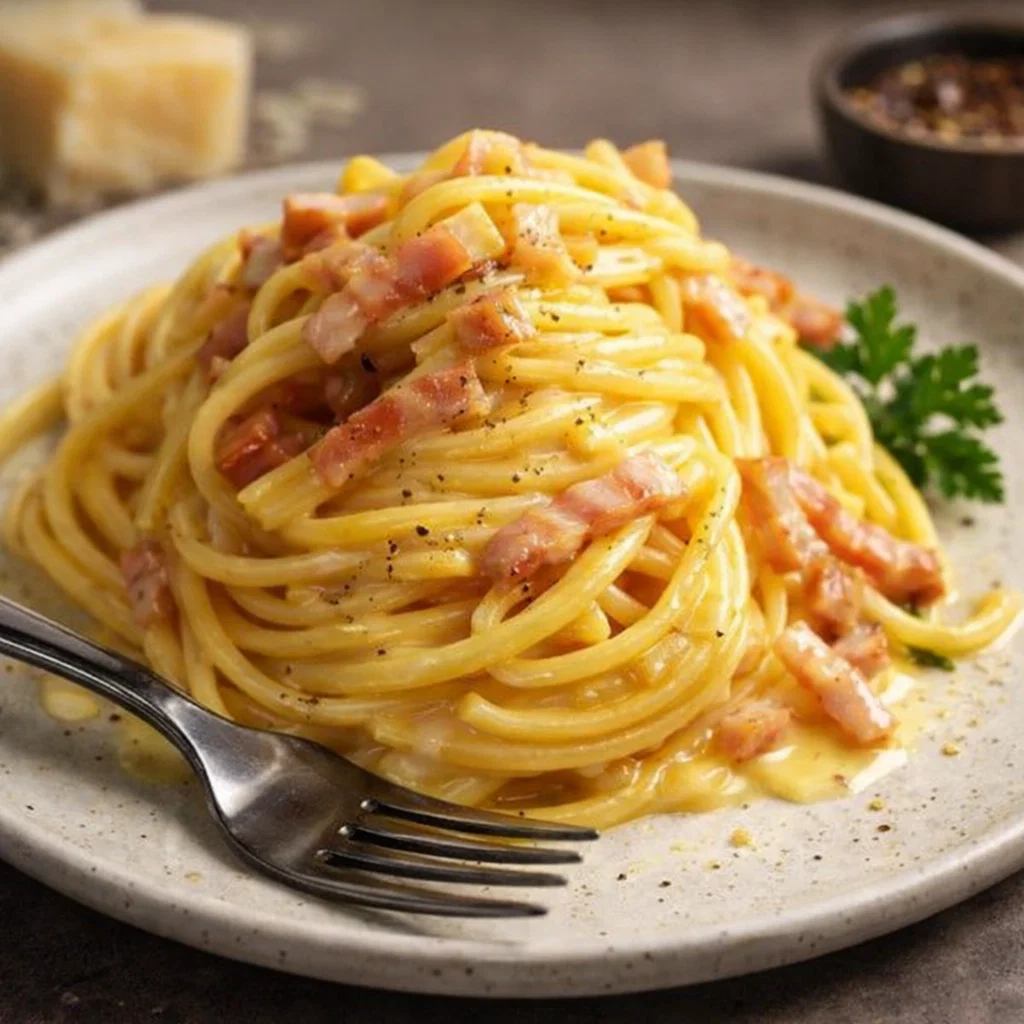
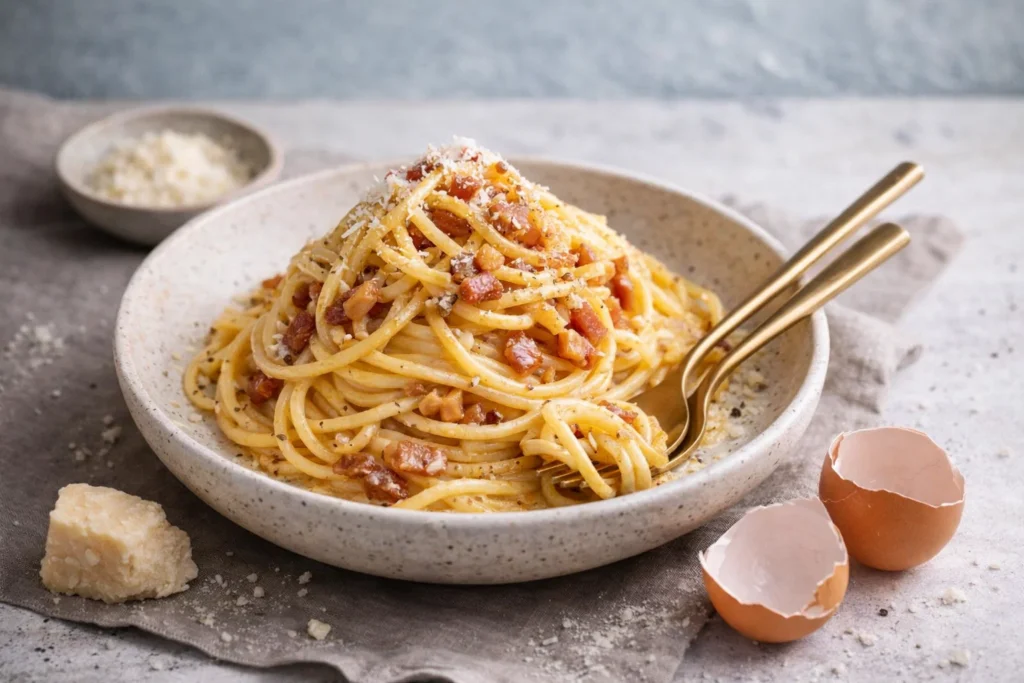
Instructions
Step 1 — Prep: Cut guanciale into thick batons (1 cm x 3–4 cm). Whisk eggs, extra yolks, finely grated cheese, and generous black pepper together in a large bowl until completely smooth. Set aside near (not on) the stove. Bring a large pot of well-salted water to a rolling boil.
Step 2 — Render the Guanciale: Place guanciale in a cold, dry skillet. No oil. Heat to medium and cook for 5 to 7 minutes, turning occasionally, until deeply golden on all sides and fat is fully rendered into the pan. Remove from heat. Do not discard the rendered fat.
Step 3 — Cook the Pasta: Cook spaghetti in boiling salted water until al dente (firm at the center). Reserve 1 full cup of pasta cooking water before draining. Drain.
Step 4 — Coat in Guanciale Fat: Add drained pasta to the skillet with guanciale and rendered fat. Toss over low heat for 30 seconds until every strand is coated in fat. Remove pan from heat entirely.
Step 5 — Build the Emulsion: Transfer pasta and guanciale to the large bowl with the egg and cheese mixture. Add a generous splash (approximately ¼ cup) of reserved pasta water. Using the handle of a wooden spoon, toss and stir vigorously and continuously, adding pasta water splash by splash until the sauce is glossy, silky, and coats every strand. Work quickly — the goal is emulsification, not scrambled eggs.
Step 6 — Serve Immediately: Plate into pre-warmed bowls. Top with additional finely grated cheese and a generous crack of black pepper. Serve immediately — carbonara waits for no one.
Technical Notes and Safety Information
Raw egg safety: The residual heat from the pasta and guanciale fat raises the temperature of the egg mixture sufficiently to produce a safe, cooked-through sauce when the technique is followed correctly. For individuals who are pregnant, immunocompromised, very young, or elderly and who are concerned about raw eggs, use pasteurized eggs.
Storage: This authentic carbonara recipe is best eaten immediately after plating. Leftovers can be stored in an airtight container in the refrigerator for up to 3 days — however, the emulsion will break during refrigeration and the texture will change significantly. To reheat, add a splash of water and warm gently in a pan over very low heat, tossing continuously. Accept that the reheated version is a different (though still acceptable) dish.
Freshness is best: Carbonara made fresh and eaten immediately is in a categorically different class from any stored or reheated version. Make only what you will eat.
VIII. Community and Reader Results
What Readers Are Achieving With This Authentic Carbonara Recipe
The most consistent feedback from readers who have followed this authentic carbonara recipe for the first time centers on a single moment of surprise: the realization that the sauce — which looked alarmingly insufficient in the bowl before the pasta went in — transformed into something genuinely restaurant-quality once the tossing and emulsification began.
“Restaurant quality” is the phrase that appears in reader comments more than any other. Home cooks who were convinced they could not make carbonara without cream — who had tried and failed with less technique-focused recipes — describe the moment the emulsion comes together as genuinely exciting. Parents report making it for children who declared it better than any pasta they had eaten in a restaurant. Readers who have made it for Italian-born friends or family members report receiving specific, explicit approval from the most demanding possible audience for an authentic carbonara recipe.
The community of readers who have mastered this dish — who have internalized the off-the-heat rule, the pasta water ratio, the wooden spoon handle technique — have become advocates for the no-cream position in their own kitchens and among their own families. Once you have tasted the real thing made correctly, the cream version simply stops being an option.
Your Turn: Rate, Review, and Share
If this authentic carbonara recipe delivered the restaurant-quality result in your kitchen — or if you used the pancetta or streaky bacon substitution and found it genuinely very respectable — leave a star rating and review below. The most valuable reader feedback includes which cheese combination you used, how many extra egg yolks you added, and whether you used the wooden spoon handle technique for the first time and found it effective.
Share your variations. Share your mistakes and what you learned from them. Share the moment the emulsion came together and the sauce became something genuinely extraordinary from four humble ingredients.
The first time you make this authentic carbonara recipe correctly — the moment the pasta water and egg yolks and guanciale fat come together into something silky and luxurious and deeply, unmistakably Roman — you will understand why the no-cream rule is not a restriction. It is an invitation to something better.