
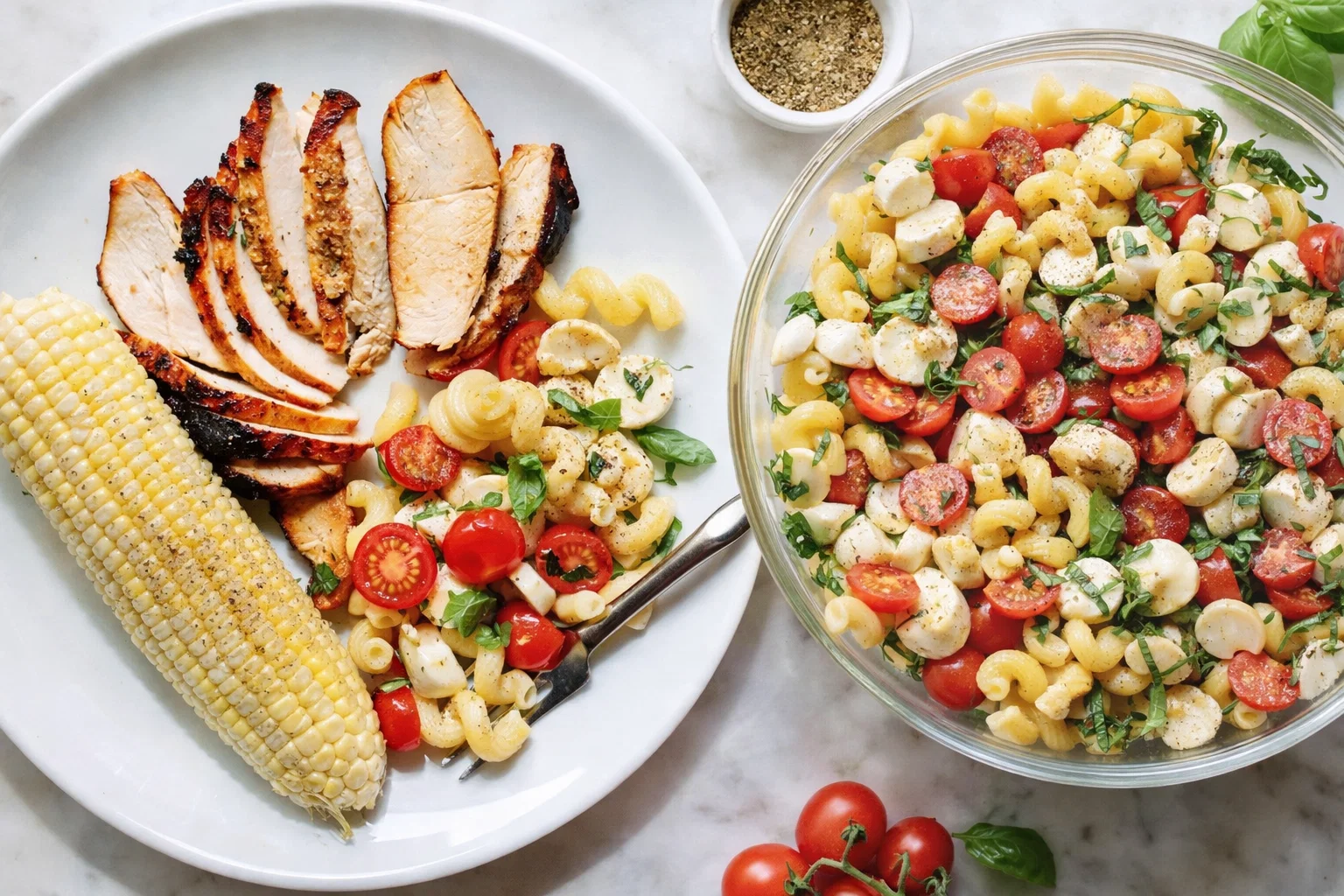
Caprese Pasta Salad
Table of Contents
There are recipes that convert people — dishes that take someone who has declared a firm, confident position against an entire food category and quietly, efficiently change their mind within a single serving. This caprese pasta salad is that recipe for pasta salad skeptics. The people who find standard pasta salads heavy, mayonnaise-laden, and texturally monotonous try this version and revise their position immediately — because this is not a standard pasta salad. It is bright, fresh, and genuinely craveable in a way that feels more like a summer caprese plate than a traditional pasta salad preparation.
Thank you for reading this post, don't forget to subscribe!25 minutes from start to finish. A handful of quality ingredients — cherry tomatoes, fresh mozzarella, basil, and a golden balsamic dressing — that come together in a flavor combination so well-established and so beloved that it barely needs improvement, only the right execution. As a BBQ side dish it is the most visually impressive option on the table. As a standalone meatless entree it is complete, satisfying, and substantial enough to serve as a full meal with nothing else required.
And while this easy caprese pasta salad has a natural home in summer — when basil is abundant and tomatoes are at peak sweetness — the use of cherry tomatoes rather than large garden tomatoes makes it a genuinely viable year-round recipe. Cherry tomatoes maintain their flavor, their color, and their sweetness across seasons in a way that large slicing tomatoes simply do not — meaning this salad can appear on the table in February with the same result it produces in July.
The Secret to a Beautiful Salad: Choosing the Right Balsamic
The No-Brown Secret That Changes Everything
The single most visually distinctive quality of a great fresh caprese pasta salad — the vibrant, jewel-toned appearance where the white mozzarella, red tomatoes, and green basil pop against the pasta with no muddying or discoloration — depends on one ingredient decision that most recipes overlook entirely: use golden or white balsamic vinegar instead of regular dark balsamic.
Standard dark balsamic vinegar is deeply colored and produces a brownish tinge on the pasta and mozzarella within minutes of dressing — the result is a salad that tastes fine but looks significantly less appealing, with the characteristic white mozzarella turning gray-tinged and the pasta taking on a muddy tone. Golden balsamic vinegar is made from white Trebbiano grapes rather than the dark grape varieties used for standard balsamic — it is lighter in color, slightly sweeter in flavor, and considerably less acidic. The result is a dressing that provides all the complex sweet-tart depth associated with balsamic vinegar while keeping the salad looking as vibrant and fresh after two hours of sitting as it did immediately after assembly.
White balsamic vinegar achieves the same visual result with a slightly sharper, more acidic flavor profile. Both are available at most well-stocked grocery stores — either produces a beautiful caprese salad that looks as good as it tastes.
Ingredients: The Quality Checklist
The Pasta: Shape Matters
The pasta shape in this homemade caprese pasta salad is a functional choice as much as an aesthetic one. Short, sturdy shapes — cavatappi (the corkscrew shape), fusilli, penne, or shells — are specifically recommended over long pasta shapes for three practical reasons. First their compact size means the dressing, tomato juices, and oil coat every surface of every piece evenly. Second their structural integrity holds up through the dressing and resting period without becoming limp or losing their shape. Third their cavities, ridges, and tubes hold the dressing inside and between the pasta pieces rather than allowing it to pool at the bottom of the bowl — every forkful carries dressing rather than just the pieces closest to the bottom.
Long pasta shapes — spaghetti, linguine, penne — tangle, clump, and drain their dressing to the bottom. Short sturdy shapes distribute it throughout.
The Mozzarella: Pearls vs. Ciliegine
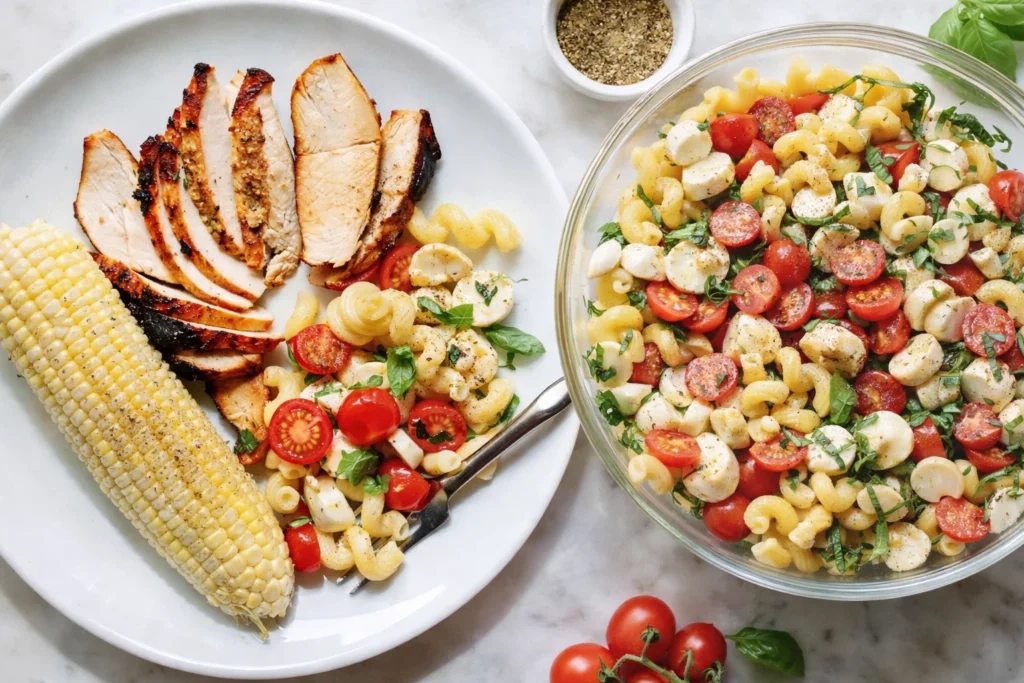
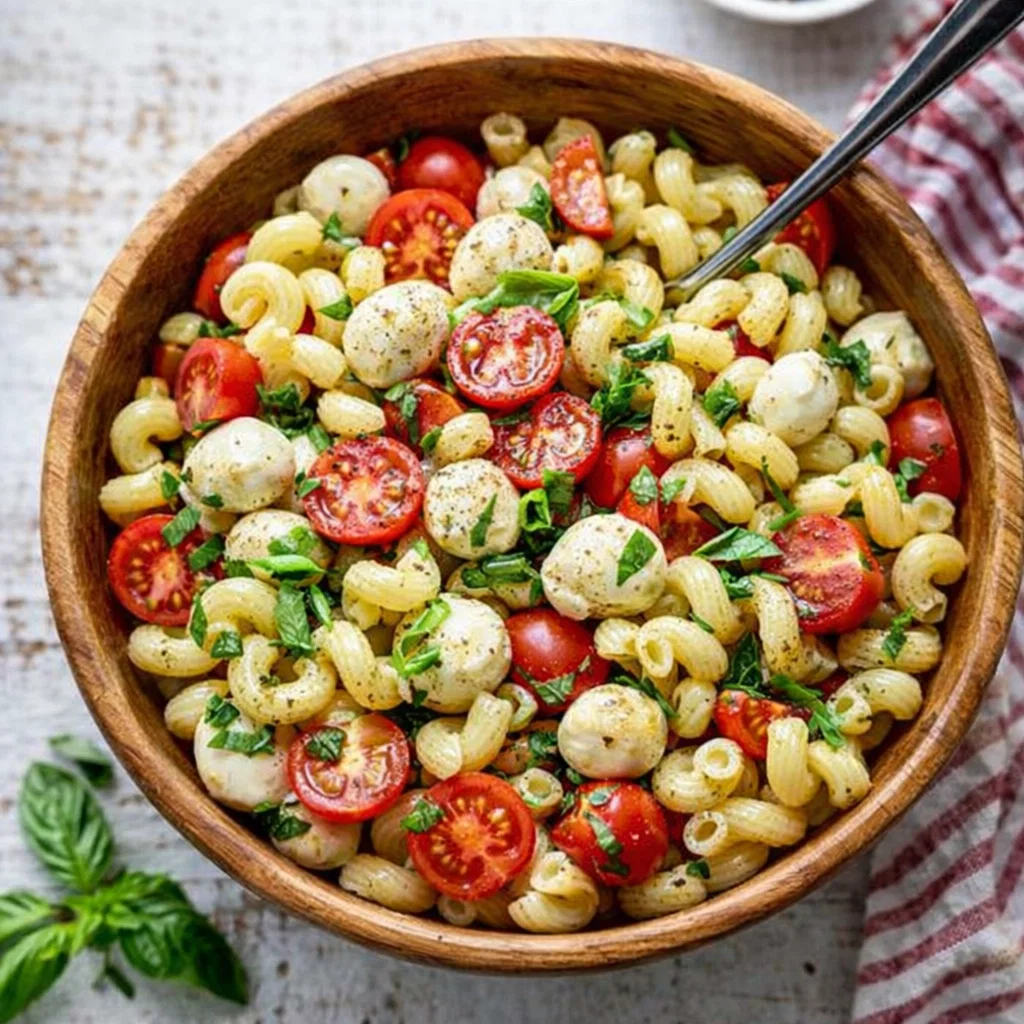
Two fresh mozzarella formats work well in this Italian pasta salad — each with slightly different practical and visual results. Mozzarella pearls are small, pea-sized balls that distribute evenly throughout the salad and provide a clean, delicate cheese bite in every forkful. Ciliegine are cherry-sized balls — larger, more substantial, and more visually impressive. For ciliegine the recommended technique is to slice each ball in half before adding to the salad: halving makes them go further throughout the dish, increases their surface area for dressing absorption, and produces a more uniform distribution so that every serving contains adequate cheese rather than some servings being cheese-rich and others cheese-sparse.
Both formats should be fresh mozzarella packed in water — not low-moisture shredded or block mozzarella, which lacks the soft, milky, yielding texture that makes caprese-style preparations so satisfying.
The Tomatoes: Cherry Over Garden
Cherry tomatoes are the correct tomato choice for this best caprese pasta salad — and the reason is practical and textural rather than purely flavor-based. Large garden tomatoes, when halved or quartered for a pasta salad, become what can only be described as tomato bombs — pieces with so much internal juice and seeds that they collapse, release their liquid into the dressing, and produce watery pockets of tomato flesh that are simultaneously too wet and too soft. Cherry tomatoes, halved, provide a compact piece with manageable juice content, a clean cut edge, and enough flesh-to-skin ratio to hold their shape through the resting period and service without deteriorating.
Multicolored cherry tomatoes — a mix of red, yellow, and orange — add visual variety and slightly different flavor nuances that make the finished salad more interesting visually and on the palate.
The Oil: Quality Finishing EVOO
The extra-virgin olive oil in the dressing for this caprese salad recipe should be a light, bright, fruity variety — one with a clean, grassy, slightly peppery character rather than a heavy, robust, or bitter one. The oil is a primary flavor component of the dressing rather than a neutral carrier — its quality is directly detectable in the finished salad. A good supermarket extra-virgin olive oil labeled “light” or “mild” works well. A single-origin Italian or Spanish EVOO with fruity tasting notes is excellent. The worst choice is an old, oxidized, or very pungent oil — both off-flavors and excessive bitterness will dominate the dressing.
Step-by-Step: The Cook, Mix, Toss Method
The Al Dente Rule: Undercook Deliberately
Cook the pasta for 1 to 2 minutes less than the package directions specify for al dente — a counterintuitive instruction that produces the best finished result. Pasta that is cooked to perfect al dente before dressing will be overcooked and slightly mushy after absorbing the dressing and tomato juices during the 30-minute resting period. Deliberately undercooked pasta firms enough to withstand the dressing absorption and arrives at the serving table at exactly the right texture. This is one of the most practically important technique adjustments in this easy caprese pasta salad recipe and one of the most commonly overlooked.
The Rinsing Debate: Yes, Rinse This One
The standard professional advice — never rinse cooked pasta — applies to hot pasta dishes where the surface starch helps sauce adhere. For cold pasta salad the calculus is entirely different. Rinsing the cooked pasta under cold water after draining achieves three things simultaneously: it stops the cooking immediately and precisely, it removes the surface excess gluten that causes pasta strands and pieces to stick together as they cool, and it drops the pasta temperature to room temperature quickly so it is ready to dress without waiting. A sticky, clumped, room-temperature pasta mass is the most common pasta salad preparation failure — rinsing prevents it entirely.
The Jar Shake: Effortless Emulsification
The dressing for this balsamic caprese pasta salad — golden balsamic vinegar, extra-virgin olive oil, minced garlic, salt, and freshly ground black pepper — is assembled and emulsified in a mason jar rather than whisked in a bowl. The technique: add all dressing ingredients to the jar, seal the lid tightly, and shake vigorously for 20 to 30 seconds. The jar shake produces a more complete, more stable emulsification than whisking because the sealed container forces the oil and vinegar into continuous contact with each other rather than allowing them to separate to opposite sides of an open bowl. The dressing stays emulsified longer — meaning every forkful of salad gets a uniformly dressed bite rather than an oily or acidic one.
The Resting Period: 30 Minutes Is Non-Negotiable
After assembling the complete fresh caprese pasta salad — pasta, mozzarella, cherry tomatoes, basil, and dressing all combined — allow the salad to rest for 30 minutes before serving. During this period the pasta absorbs the dressing and the tomato juices, the flavors meld from a collection of separate components into a cohesive, unified dish, and the garlic in the dressing mellows from sharp and raw to integrated and savory. A freshly assembled caprese pasta salad tastes noticeably less developed than one that has rested — the 30 minutes is the step that transforms good ingredients into a genuinely great salad.
Pro Variations and Reader Success Tips
Make It a Complete Meal
For a caprese pasta salad meal that serves as a complete dinner rather than a side dish two protein additions work particularly well without disrupting the established flavor profile. Diced cooked chicken — rotisserie chicken pulled into irregular pieces or grilled chicken cut into cubes — adds mild, savory protein that complements rather than competes with the caprese flavors. Cooked shrimp — chilled and halved if large — adds a sweet, briny seafood element that pairs beautifully with the golden balsamic dressing and the fresh basil.
The Garden Harvest: Reader-Favorite Additions
The community around this summer caprese pasta salad has enthusiastically endorsed several vegetable additions that add crunch, sweetness, and color variety. Sweet corn kernels — fresh off the cob in summer, roasted frozen corn year-round — add a sweet, starchy pop that echoes the sweetness of the cherry tomatoes. Chopped cucumber adds cool, watery crunch. Diced bell pepper — red or yellow for maximum sweetness — adds color and a satisfying crisp bite. Thinly sliced red onion adds a sharp, pungent note that lifts the overall flavor profile.
Flavor Boosters: Spice and Tang
For a spicy caprese pasta salad add red pepper flakes to the dressing during the jar shake — start with ¼ teaspoon and increase to preference. The heat amplifies the garlic and vinegar notes of the dressing and adds a complexity that makes the overall flavor profile more interesting. For a more complex, more mustardy dressing add 1 teaspoon of Dijon mustard to the jar before shaking — it functions as an additional emulsifier and adds a sharp, tangy depth that makes the dressing taste more sophisticated.
The Finishing Touch: Balsamic Glaze
Immediately before serving — not in advance — drizzle balsamic glaze (balsamic reduction) over the surface of the finished Italian caprese pasta salad. Balsamic glaze is thicker, sweeter, and more intensely flavored than balsamic vinegar and provides a concentrated flavor punctuation that adds “zip” to every bite it touches. It also adds a beautiful visual element — dark glossy drizzle lines against the colorful salad surface. Use it sparingly — a little provides enormous flavor impact.
Substitution Guide
Cheese Swaps
When fresh mozzarella is unavailable or when variety is desired three alternatives work well in this caprese salad with pasta. Feta cheese — crumbled in irregular pieces — adds a saltier, tangier, more assertive flavor that takes the salad in a slightly Greek direction while maintaining the creamy cheese component. Goat cheese adds a soft, tangy, earthy richness that is particularly good with the golden balsamic dressing. Cubed brie — rind removed and cut into small cubes — adds an indulgent, buttery, slightly funky richness that makes the salad more luxurious and more substantial.
Vinegar Alternatives
When golden balsamic vinegar is unavailable two alternatives preserve the visual brightness of the salad while providing adequate acid. White wine vinegar is the most straightforward substitute — its clean, light acidity is close to golden balsamic without the sweetness. Add a small additional amount of honey or maple syrup to the dressing to compensate for the missing sweetness. Rice wine vinegar is milder and slightly sweeter — a good choice for those who find white wine vinegar too sharp.
Gluten-Free Options
This gluten-free caprese pasta salad works well with a corn and rice pasta blend — which holds its texture better than pure rice pasta during the dressing and resting process. One specific timing adjustment is required for gluten-free pasta: add the dressing only 30 minutes before serving rather than allowing the full 30-minute post-assembly rest that wheat pasta benefits from. Gluten-free pasta absorbs liquid more aggressively than wheat pasta and can become mushy if dressed too far in advance — the 30-minute window provides adequate flavor development without texture compromise.
Make-Ahead and Storage Masterclass
Advance Preparation: The 24-Hour Window
All components of this make-ahead caprese pasta salad can be prepared up to 24 hours in advance — the pasta cooked, rinsed, and stored in an airtight container; the dressing assembled in its mason jar and refrigerated; the tomatoes halved; the mozzarella sliced or portioned. Keeping these components separate until assembly preserves the quality of each element — the pasta doesn’t absorb the dressing prematurely, the tomatoes don’t release their juice into the other components, and the mozzarella stays fresh and firm.
Assembly Timing: One Hour Before Serving
For the best visual presentation and the freshest flavor assemble the complete salad no more than one hour before serving. The basil — which oxidizes and turns black when exposed to the dressing’s acidity for extended periods — looks vibrant and green for approximately one hour after assembly. The cherry tomatoes maintain their visual freshness and structural integrity most appealingly in this window. The mozzarella retains its white color and soft texture. One hour provides adequate resting time for flavor development while preserving peak visual quality.
Gluten-Free Timing Note
For gluten-free caprese pasta salad specifically reduce the dressing contact time to 30 minutes maximum — assemble and dress 30 minutes before serving rather than the one-hour window appropriate for wheat pasta. The more aggressive liquid absorption of gluten-free pasta means the shorter window is essential for maintaining proper texture.
FAQs and Troubleshooting
The Salt Confusion: Two Different Salting Stages
A common source of confusion in this easy caprese pasta salad recipe involves the salt quantity — and the answer is that there are two entirely separate salting applications that require entirely different quantities. The dressing receives 1 teaspoon of kosher salt — a moderate amount appropriate for a dressing that will be distributed across the entire salad. The pasta water should be seasoned generously — approximately 1 to 2 tablespoons of salt for a large pot of water — to properly season the pasta from the inside during cooking. Under-salted pasta water produces bland pasta that no amount of dressing can fully correct. These are two separate applications and the quantities are not interchangeable.
Pepper Ratios: Fresh vs. Pre-Ground
The dressing recipe specifies freshly ground black pepper — and the quantity assumes the more moderate, less pungent character of freshly ground. If using pre-ground black pepper from a jar use only half the specified amount — pre-ground pepper is more intensely pungent and more uniformly fine than freshly ground, and the full quantity intended for fresh-ground pepper will over-pepper the dressing significantly. Taste after adding half and add more gradually to preference.
Official Recipe Card and Serving Suggestions
Caprese Pasta Salad Prep Time: 15 minutes | Cook Time: 10 minutes | Rest Time: 30 minutes | Total Time: 25 minutes active + 30 minutes rest | Yield: 6 servings
Ingredients
For the Caprese Pasta Salad
- 12 oz short pasta (cavatappi, fusilli, penne, or shells), cooked al dente minus 1-2 minutes, rinsed and cooled
- 8 oz fresh mozzarella pearls or ciliegine (cherry-sized balls, halved)
- 2 cups cherry tomatoes, halved (multicolored recommended)
- ½ cup fresh basil leaves, torn or roughly chiffonaded
- Salt for pasta water (1 to 2 tablespoons)
For the Golden Balsamic Dressing (Mason Jar Method)
- 3 tablespoons golden balsamic vinegar or white balsamic vinegar (Alternative: white wine vinegar or rice wine vinegar + small amount of honey)
- 3 tablespoons extra-virgin olive oil (light, fruity variety)
- 1 small garlic clove, finely minced or pressed
- 1 teaspoon kosher salt
- ½ teaspoon freshly ground black pepper (If using pre-ground: use ¼ teaspoon)
- (Optional: 1 teaspoon Dijon mustard for tang and emulsification)
- (Optional: ¼ teaspoon red pepper flakes for heat)
For Finishing
- Balsamic glaze for drizzling immediately before serving
Nutritional Breakdown (Per Serving — Based on 6 Servings)
| Nutrient | Amount |
|---|---|
| Calories | 359 kcal |
| Total Fat | 18g |
| Saturated Fat | 7g |
| Protein | 14g |
| Carbohydrates | 38g |
| Dietary Fiber | 2.5g |
| Total Sugars | 4g |
| Sodium | 380mg |
| Vitamin C | 14mg |
Perfect Pairings
This classic caprese pasta salad pairs beautifully with three specific main courses that complement its Italian-inspired flavor profile. Grilled balsamic chicken — marinated in the same golden balsamic dressing — creates a cohesive, harmonious meal where the dressing ties both dishes together. Garlic burgers — beef or veggie — benefit from the bright, acidic freshness of the caprese salad as a counterpoint to their rich, savory intensity. Salmon with basil gremolata makes the most elegant pairing — the herb and citrus notes of the gremolata mirror the basil and vinegar notes of the salad in a way that makes the complete plate taste like a deliberate, thoughtfully composed meal.