
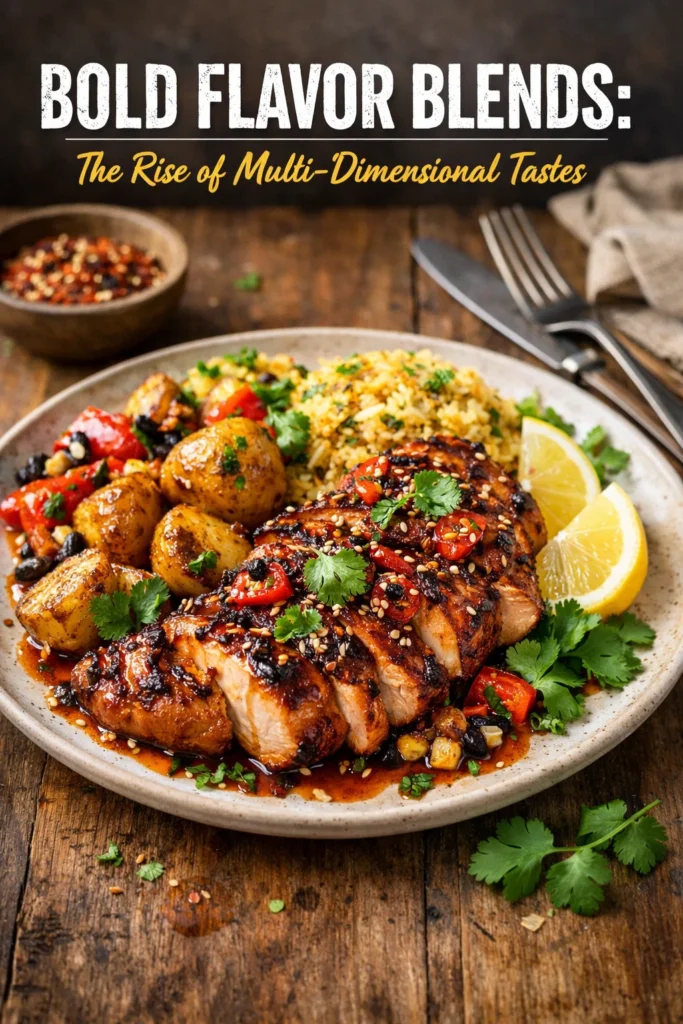
Bold Flavor Blends: The Rise of Multi-Dimensional Tastes
Table of Contents
There was a time when a well-seasoned dish meant salt, pepper, and perhaps a bay leaf if you were feeling adventurous. Those days are over. The modern culinary landscape has undergone a fundamental transformation — one driven not by a single chef or a single trend, but by a collective shift in how eaters understand and expect flavor to behave on the palate.
Thank you for reading this post, don't forget to subscribe!Today’s most compelling dishes don’t just taste good. They create what culinary professionals have begun calling a symphony of sensations — a layered, dynamic experience where sweet and spicy arrive together, where smokiness gives way to bright citrus, where heat builds slowly beneath a creamy, cooling finish. Single-note flavors feel flat by comparison. Multi-dimensional bold flavor blends have become the new baseline expectation, and the gap between those who understand this shift and those who don’t is increasingly visible on every menu, in every kitchen, and on every plate.
This isn’t a passing trend. It’s an evolution — and it’s reshaping how both home cooks and professional chefs approach every stage of meal creation, from pantry stocking to plate presentation.
The Power of Fusion: Beyond Simple Flavors
Something significant has changed in what people want when they sit down to eat. Hunger, of course, remains the starting point — but satisfaction now requires something more than being fed. Modern diners arrive at the table expecting an experience. They want their meal to take them somewhere — to evoke a memory, challenge an assumption, or deliver a flavor combination so unexpected and precise that it demands attention.
This is the appetite that has driven bold flavor blends from the fringes of specialty cuisine directly into the mainstream. Fusion cooking — once dismissed by traditional culinary purists as gimmicky or unfocused — has earned its place at the center of contemporary food culture precisely because it delivers on this demand. The interplay of heat and tanginess, the push and pull of sweetness against smokiness, the contrast of rich creaminess against sharp acidity — these dynamic flavor relationships create the vibrant culinary adventure that today’s diners are actively seeking.
The data supports this shift. Consumers across every demographic are demonstrating increased willingness to explore globally-inspired flavors, unfamiliar spice combinations, and cross-cultural ingredient pairings. What was once considered exotic or niche has become mainstream, and what was once mainstream has become baseline. The bar for flavor complexity has risen, and professional kitchens as well as ambitious home cooks are responding by reaching for bold seasoning blends that deliver multi-dimensional depth without requiring years of culinary training to execute.
Spotlight on High-Impact Bold Flavor Blends
Understanding which bold flavor blends are driving the most excitement — and why they work so effectively — is essential for any culinary professional or passionate home cook looking to stay ahead of the curve. These four profiles represent some of the highest-impact, most versatile flavor combinations currently defining modern cooking.
Coconut Curry
Few bold flavor blends achieve the balance of comfort and complexity that coconut curry delivers so consistently. The foundation is the interplay between rich, naturally sweet coconut milk and the deeply aromatic spice profile of a well-constructed curry blend — typically built around turmeric, cumin, coriander, and warming notes of cinnamon and cardamom. The result is simultaneously creamy and vibrant, mild enough to be broadly accessible and layered enough to reward careful attention.
What makes coconut curry such a powerful culinary flavor blend is its versatility across proteins and vegetables. It wraps around poultry with a richness that makes white meat genuinely satisfying, elevates seafood with sweet aromatic warmth that complements rather than overwhelms, and transforms vegetables into a cohesive, deeply flavored dish that stands confidently on its own. As a base for soups, braises, grain bowls, and sauce applications, coconut curry is one of the most productive bold blends any kitchen can have in consistent rotation.
Thai Lemongrass
If coconut curry represents warmth and richness, Thai lemongrass flavor blends represent brightness and lift. The profile is built on lemongrass’s distinctive citrusy, slightly floral character — fresh, clean, and immediately recognizable — balanced against the earthy, spicy warmth of ginger and the savory depth of garlic. Fish sauce and lime juice add umami and acidity that tie the whole profile together into something both bold and remarkably balanced.
This is a global spice blend that excels in applications where clarity of flavor matters as much as depth. Thai lemongrass blends bring structure and brightness to soups and broths, add aromatic complexity to stir-fries, and work beautifully as marinades for chicken, shrimp, and firm tofu. In a culinary landscape increasingly drawn to fresh, herb-forward flavor profiles, Thai lemongrass represents one of the most relevant and high-performing bold flavor combinations available to both professional and home kitchens.
Sweet Chili
The sweet chili flavor blend might be the most immediately accessible entry point into multi-dimensional bold cooking — and yet it’s also one of the most strategically versatile profiles in the modern culinary toolkit. Its power lies in what culinary professionals describe as a near-perfect marriage of sweetness and heat: the sugar-forward base creates immediate palatability and broad appeal, while the chili component builds a slow, satisfying warmth that keeps the flavor interesting long after the first bite.
This dynamic makes sweet chili an extraordinary bold flavor blend for a wide range of applications. As a glaze it caramelizes beautifully under high heat, creating sticky, lacquered surfaces on proteins that are visually dramatic and intensely flavorful. As a dipping sauce it provides the kind of versatile kick that complements everything from spring rolls to grilled chicken to roasted vegetables. As a finishing element in dressings and vinaigrettes it adds a dimension of complexity that transforms a simple salad into something genuinely exciting. Sweet chili is the bold seasoning blend that earns its place in professional and home kitchens alike by consistently delivering more than expected.
Makhani Sauce
Makhani sauce — the rich, deeply spiced base behind the beloved butter chicken and dal makhani — represents one of the most sophisticated bold flavor blends in the global culinary canon. Built on a vibrant foundation of ripe tomatoes and cream, it achieves its extraordinary depth through a carefully balanced spice architecture: cloves for subtle sweetness and warmth, cardamom for floral aromatic lift, coriander for earthy brightness, and fresh ginger for a clean, spicy edge that cuts through the richness and keeps the profile dynamic.
The result is a sauce that is simultaneously bold and luxurious — complex enough to reward attention, approachable enough to achieve broad appeal. Makhani’s ability to elevate chicken concepts is well established, but its applications extend significantly further. It transforms flatbread concepts into deeply satisfying centerpiece dishes, serves as a sophisticated base for vegetarian proteins like paneer and chickpeas, and brings an unmistakable depth to roasted vegetable applications that few other global flavor blends can match. For professional kitchens looking to bring authentic, high-impact Indian-inspired flavors to their menus without extensive specialty training, Makhani sauce represents one of the most powerful and practical bold culinary blends available.
Practical Kitchen Integration and Innovation
Understanding a bold flavor blend is one thing. Knowing how to integrate it strategically across a kitchen’s full range of applications is what separates cooks who use these profiles occasionally from those who leverage them to consistently elevate every dish they produce.
Strategic Infusion Through Marinades
The marinade is one of the most powerful vehicles for bold seasoning blends because it allows flavor to penetrate proteins and vegetables from the inside out rather than sitting exclusively on the surface. A coconut curry marinade applied to chicken thighs several hours before cooking produces a fundamentally different — and significantly more flavorful — result than the same blend applied as a sauce at the end. Thai lemongrass blends work exceptionally well as marinades for shrimp and firm tofu, driving clean aromatic flavor deep into the ingredient before cooking concentrates and caramelizes the surface. For vegetable applications, a 30-minute marinade in a sweet chili or makhani-inspired blend before roasting delivers a depth of flavor that finishing sauces simply cannot replicate.
Sauce and Glaze Upgrades
One of the most practical ways to integrate bold flavor blends into an existing kitchen program is through targeted upgrades to standard dressings, sauces, and glazes. A house vinaigrette gains immediate complexity from the addition of a measured squeeze of lime and a teaspoon of sweet chili. A standard teriyaki glaze becomes something more interesting with the addition of coconut milk and lemongrass. A tomato-based pasta sauce develops unexpected depth when Makhani spice elements — cardamom, coriander, a touch of cream — are worked in with care. These are not radical reinventions; they are strategic additions of bold flavor combinations that reward diners with something more dimensional than they expected.
Thinking Beyond the Obvious
The most exciting applications of bold seasoning blends often emerge from deliberately unconventional pairings. Sweet chili glazes on roasted root vegetables — carrots, parsnips, butternut squash — create a caramelized, spicy-sweet profile that challenges expectations and consistently delights. Chili-lime seasoning on fresh fruit — watermelon, mango, pineapple — is a well-established street food tradition across Latin America and Southeast Asia that translates powerfully to contemporary menu applications. Coconut curry as a base for roasted cauliflower steaks positions a humble vegetable as a compelling centerpiece. These unconventional applications are where bold flavor blends demonstrate their fullest potential — not by following established patterns but by creating new ones.
The Future of Global Flavors in Institutional Dining
The rise of bold flavor blends in consumer-facing restaurants and home kitchens is only part of the story. Equally significant — and in many ways more challenging — is the translation of these culinary trends into institutional dining environments where scale, consistency, budget constraints, and diverse population needs create a fundamentally different set of requirements.
The trajectory is clear: institutional dining sectors including healthcare, schools, and corrections are increasingly expected to deliver food experiences that reflect the same flavor ambitions as the broader culinary culture. Patient satisfaction scores in healthcare settings are directly influenced by food quality. Student participation in school meal programs correlates with menu appeal. Institutional operators who continue to default to lowest-common-denominator flavor profiles will find themselves falling further behind the expectations of the populations they serve.
Bold flavor blends offer a practical pathway to closing this gap. Pre-formulated, professionally developed flavor profiles like coconut curry, Thai lemongrass, sweet chili, and Makhani sauce allow institutional kitchens to deliver sophisticated, globally-inspired flavor without requiring specialized culinary training at scale. High-performance wholesale food service distribution — built around consistent quality, reliable supply chains, and purpose-formulated blends designed for institutional application — makes this translation from trend to practice both achievable and economically viable.
The food service operators and distributors who anticipate this demand and position their product offerings accordingly will define the next generation of institutional dining. The expectation of bold, multi-dimensional flavor is not a niche preference — it is becoming a universal standard, and the institutional sector is not exempt from that evolution.
Transforming the Chef’s Table: A Call to Culinary Experimentation
The evolution from simple seasoning to bold flavor blends is not a trend to observe from a distance — it’s an invitation to participate. Every kitchen, regardless of size, budget, or audience, has access to the same fundamental building blocks: the sweetness of coconut milk, the heat of chili, the brightness of lemongrass, the aromatic depth of cardamom and coriander. What separates extraordinary food from ordinary food is the willingness to combine these elements with intention, curiosity, and a genuine commitment to creating something more than just a meal.
As Chef Richard A. Reilly — a leading voice in modern wholesale food service distribution strategy — has noted, the future of professional cooking at every level depends on understanding that flavor is not a finishing touch. It is the strategy. Building menus, training kitchen teams, and structuring distribution programs around high-impact bold flavor blends is not a luxury reserved for fine dining establishments — it is a practical, high-return investment in the dining experience that every operator, at every scale, can and should be making.
The culinary landscape has shifted. The diners have arrived with new expectations. The bold flavor blends are ready.
The question is whether your kitchen is ready to use them.