
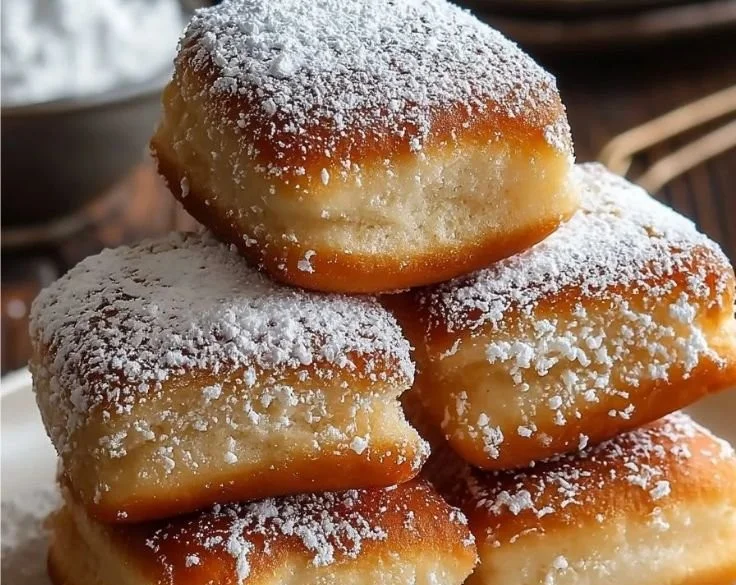
Vanilla French Beignets
Table of Contents
There are foods that satisfy hunger and foods that create genuine moments of joy — the kind of eating experience that stops conversation, generates involuntary sounds of appreciation, and produces the immediate, unanimous verdict that these need to be made again. Vanilla French Beignets belong emphatically in the second category. Light and pillowy at the center, golden and slightly crisp at the edges, fragrant with pure vanilla, and buried under a snowfall of powdered sugar that coats everything within a two-foot radius the moment anyone bites into one — these are the pastries that built the breakfast culture of the French Quarter and have been making people unreasonably happy ever since.
Thank you for reading this post, don't forget to subscribe!The vanilla beignet is a study in the beauty of simplicity done with precision. The ingredient list is short. The technique is accessible to any home cook willing to learn the few critical variables that separate an outstanding beignet from a merely adequate one. And the result — hot, fragrant, impossibly light squares of fried dough dusted with confectioners’ sugar and served alongside café au lait — is one of the most genuinely delightful eating experiences that a home kitchen can produce.
This is the homemade French beignet masterclass — the complete guide to understanding, making, and perfecting these iconic pastries from dough science to frying physics to storage and reheating.
The Essence of the Beignet
Defining the Sensory Experience
The defining quality of a great Vanilla French Beignet is the textural contrast that happens in a single bite — the very slight resistance of the golden exterior giving way instantly to an interior so light, so airy, and so pillowy that it barely registers as substance before dissolving into warm, vanilla-scented richness. This is not accidental. It is the direct result of properly developed yeast dough, correctly maintained frying temperature, and the specific enrichment that butter, milk, and egg provide to what would otherwise be a simple flour-and-water dough.
The addition of pure vanilla extract is what distinguishes these French Quarter beignets from their plainer counterparts. Vanilla introduces a fragrant, warm, slightly floral depth that elevates the otherwise neutral dough into something that smells as extraordinary as it tastes — the kind of aroma that brings people into the kitchen from other rooms and sets an expectation that the finished product fully delivers on.
A Culinary Journey: From France to New Orleans
The beignet’s story is a geographical and cultural journey that spans centuries and continents. Originating in France as a simple fried pastry — the word itself means “fritter” or “bump” in French — beignets traveled to Louisiana with French colonial settlers and found their permanent home in the Creole cooking tradition of New Orleans. The combination of French culinary technique with the ingredients, flavors, and cultural practices of Louisiana produced the specific version of the beignet that became iconic — and that Café Du Monde in the French Quarter has been serving continuously since 1862, making it one of the most enduring and beloved pastry traditions in American culinary history.
The New Orleans beignet is today inseparable from the identity of the French Quarter — as much a symbol of the city’s culinary heritage as jazz is of its musical heritage. Making these authentic French beignets at home is an act of connection to that tradition.
The Science of the Dough
Ingredient Mechanics: What Each Component Does
Understanding why each ingredient in homemade beignet dough is present makes the difference between following a recipe mechanically and understanding it deeply enough to troubleshoot, adapt, and consistently reproduce excellent results.
Flour provides the structural foundation — the gluten network formed when flour proteins hydrate and align during kneading creates the elastic, extensible structure that traps the carbon dioxide produced by yeast fermentation and allows the dough to rise and expand during both proofing and frying. The type of flour matters: all-purpose flour provides the right balance of protein content for the tender but structured crumb that beignets require.
Yeast is the leavening agent that gives yeast-risen beignets their characteristic airy lightness — fundamentally different from baking powder-leavened doughnuts in texture, flavor, and structure. Yeast feeds on the sugars in the dough and produces carbon dioxide gas that becomes trapped in the gluten network, creating the thousands of tiny air pockets that produce the pillowy interior. Yeast also produces alcohol and organic acids as fermentation byproducts — these compounds contribute to the complex, slightly tangy flavor notes that develop during the proofing period and that differentiate yeasted dough from chemically leavened alternatives.
Sugar performs two distinct functions simultaneously: it provides sweetness and it tenderizes the dough by interfering with gluten development, producing a more tender, less chewy crumb than an unsweetened dough would have. Salt regulates yeast activity — without it, yeast ferments too rapidly, producing an overly yeasty flavor and a dough that rises unevenly. Salt slows the fermentation to a controlled, even pace that develops better flavor and more consistent texture.
Milk, butter, and egg are the enriching agents that transform basic bread dough into the rich, tender, indulgent dough that authentic beignets require. Milk provides liquid and lactose that contributes to browning during frying. Butter adds richness and flavor and inhibits gluten development slightly, contributing further to tenderness. Egg provides additional richness, contributes to the golden color of the finished beignet, and helps emulsify the fat and water components of the dough into a cohesive, stable mixture.
Flavor Science: What Happens During Proofing and Frying
The flavor complexity of a great French vanilla beignet is not solely a function of the ingredients added — it is also created by the processes those ingredients undergo during preparation. During yeast fermentation in the proofing period, the yeast produces not just carbon dioxide but also a range of flavor compounds — esters, aldehydes, and organic acids — that give properly proofed yeasted dough its characteristic depth and complexity. This is why rushed, under-proofed dough produces beignets that taste flat and bready while properly proofed dough produces beignets with a genuine, developed flavor character.
During frying, the surface of the beignet undergoes the Maillard reaction — the same browning reaction responsible for the complex flavors in roasted coffee, seared meat, and toasted bread. The combination of the dough’s sugar content and the vanilla compound interact during this high-heat browning to produce subtle caramel-like flavor notes in the exterior crust that complement the vanilla fragrance of the interior.
Professional Execution and Techniques
The Perfect Proof
The proofing environment for homemade beignet dough is as important as the dough formula itself. Yeast activity is temperature-sensitive — too cold and the yeast is sluggish, producing a dough that rises too slowly or not at all; too warm and the yeast is overactive, producing off-flavors and a dough that rises too quickly before adequate flavor development occurs. The ideal proofing temperature range is 75°F to 80°F — warm but not hot.
The most reliable home kitchen proofing environment: place the covered dough bowl in a turned-off oven with a bowl of freshly boiled hot water on the rack below. The steam from the hot water creates a warm, slightly humid environment that maintains ideal proofing conditions without any risk of overheating. Allow the dough to proof for approximately 1.5 hours until it has doubled in volume — test by pressing a floured finger approximately ½ inch into the dough; if the indentation holds without springing back, the dough is properly proofed.
Dough Handling for Optimal Results
Proper kneading is the technique that develops the gluten structure necessary for light airy beignets. Knead the dough for 8 to 10 minutes by hand — using the push-fold-turn rhythm of folding the dough over itself, pressing forward with the heel of your hand, and rotating 90 degrees before repeating. The properly kneaded dough should be smooth, slightly tacky without sticking to clean dry hands, and elastic enough to stretch without tearing immediately.
When rolling for shaping, work the rested, risen dough to a uniform ¼ inch thickness across the entire surface — inconsistent thickness produces beignets that cook unevenly, with thicker portions remaining doughy while thinner portions become overcooked. Use a rolling pin with guide rings or place ¼-inch dowels on either side of the dough as thickness guides if consistent rolling is difficult.
The Physics of Frying
The most technically critical variable in frying beignets is oil temperature — specifically, maintaining a consistent 360°F throughout the frying process. This specific temperature is not arbitrary: it is the range at which the water in the dough surface converts to steam rapidly enough to create the internal expansion that produces the puffed, airy structure, while the exterior cooks at the right pace to develop golden color and a slight crust without burning.
Oil that is too cool (below 340°F) does not produce rapid enough steam generation — the dough absorbs oil before the exterior seals, producing greasy, dense beignets that feel heavy and unpleasant. Oil that is too hot (above 380°F) burns the exterior before the interior has time to cook through — producing beignets that are dark and bitter outside and raw doughy inside.
Use a deep-fry or candy thermometer clipped to the side of the pot and monitor the temperature continuously throughout frying. Adjust the heat source up or down as needed to maintain 360°F — temperature management is the single most important active skill in producing perfect homemade beignets.
Batch Management
Frying beignets in small batches is not a suggestion — it is a requirement for maintaining the oil temperature that produces the correct result. Every piece of room-temperature dough added to hot oil drops the oil temperature — the larger the batch, the larger the drop. Too many pieces at once drops the temperature below the acceptable range and produces the greasy, oil-saturated result described above.
Fry in batches of 3 to 4 pieces maximum for a standard home pot, allowing the oil temperature to return fully to 360°F between batches before adding the next group.
The Recipe: Step-by-Step Mastery
Vanilla French Beignets Prep Time: 1 hour 30 minutes | Cook Time: 30 minutes | Total Time: 2 hours | Yield: 12 servings
Ingredients
For the Beignet Dough
- 2¼ teaspoons active dry yeast (one standard packet)
- ¾ cup whole milk, warmed to 110°F
- 3 tablespoons granulated sugar
- 2 tablespoons unsalted butter, melted and slightly cooled
- 1 large egg, room temperature
- 1½ teaspoons pure vanilla extract
- 2½ cups all-purpose flour, plus extra for dusting
- ½ teaspoon kosher salt
- Neutral oil with high smoke point (vegetable, canola, or sunflower) for frying
For Finishing
- 1½ cups confectioners’ sugar, sifted
- Café au lait for serving
Step 1: Activate the Yeast
In a large mixing bowl combine the warm milk (110°F), melted butter, and vanilla extract. Sprinkle the yeast over the surface and add a pinch of the measured sugar. Whisk gently to combine and allow to sit for 5 to 10 minutes until the surface is visibly foamy and fragrant — this confirms the yeast is alive and active. If no foam develops after 10 minutes the yeast is not active — discard and begin again with fresh yeast.
Step 2: Build the Dough
In a separate bowl whisk together the flour, remaining sugar, and salt. Add the beaten egg to the yeast mixture and whisk to combine. Gradually add the flour mixture to the wet ingredients — adding approximately ½ cup at a time and stirring after each addition until a shaggy, rough dough forms. Turn out onto a lightly floured surface and knead for 8 to 10 minutes until smooth, elastic, and slightly tacky. Shape into a ball, place in a lightly oiled bowl, cover with plastic wrap, and proof for 1.5 hours until doubled.
Step 3: Shape the Beignets
Punch the risen dough down and turn out onto a lightly floured surface. Roll to a uniform ¼ inch thickness. Using a sharp knife or pizza cutter cut the dough into 2×2 inch squares — cut decisively without sawing to maintain clean edges. Transfer the cut squares to a parchment-lined baking sheet and allow to rest for 10 minutes while the oil heats.
Step 4: Fry to Golden Perfection
Heat 3 to 4 inches of neutral oil in a heavy-bottomed pot or Dutch oven over medium heat until the thermometer reads 360°F. Working in batches of 3 to 4 pieces carefully lower the dough squares into the hot oil. Fry for 1 to 2 minutes per side until puffed, golden brown, and visibly expanded. The beignets will flip themselves naturally when the underside is ready — if they don’t flip after 2 minutes turn them gently with tongs or a spider strainer. Remove immediately with a spider strainer and drain on a paper towel-lined plate. Allow the oil to return to 360°F before adding the next batch.
Step 5: Dust and Serve Immediately
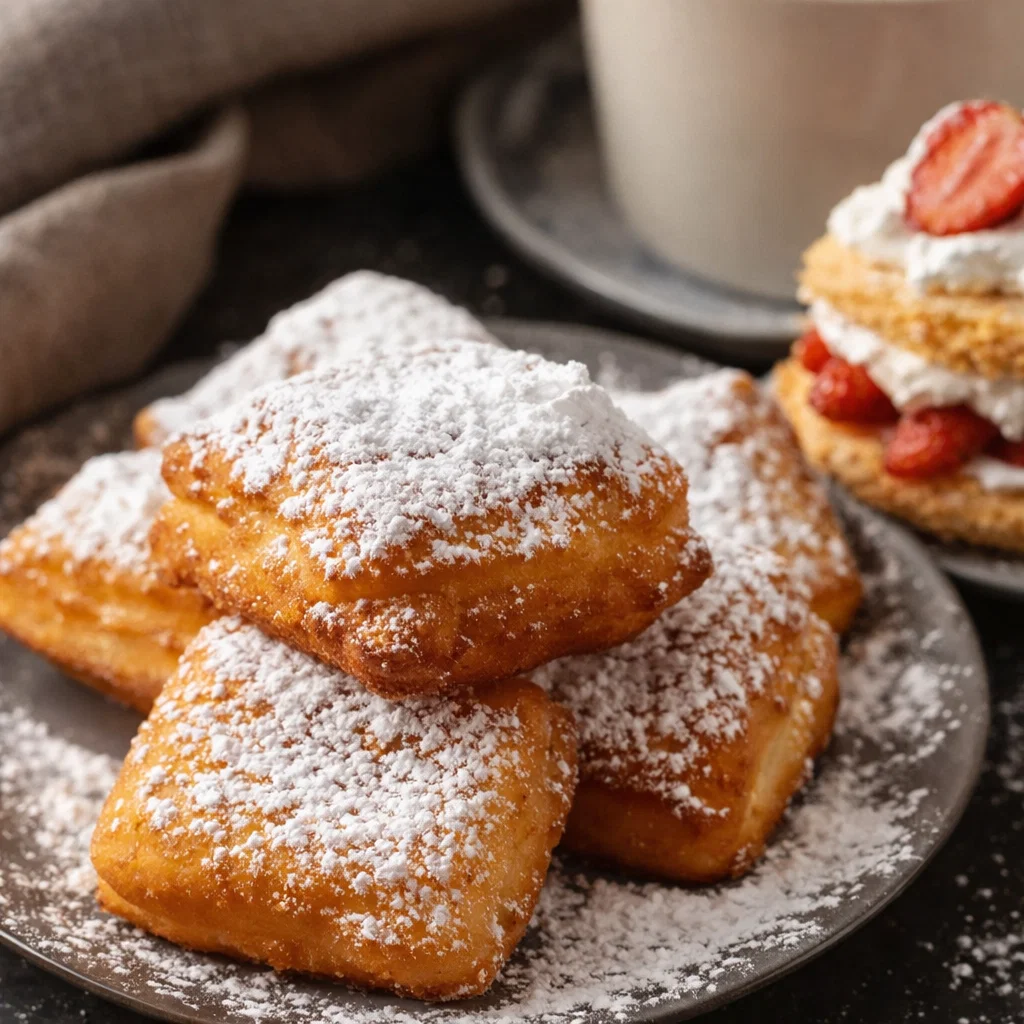
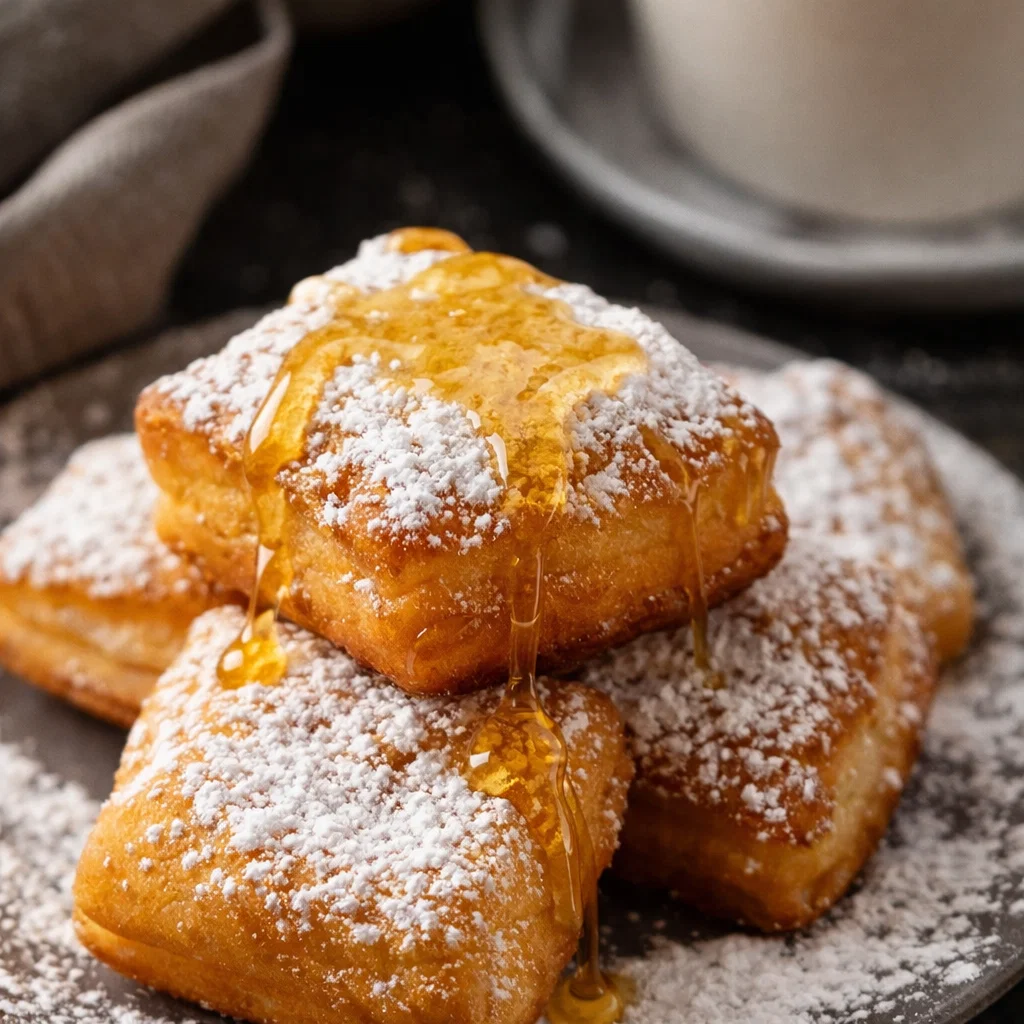
While the beignets are still hot transfer them to a serving plate and dust immediately and very generously with sifted confectioners’ sugar — the sugar should be heavy enough to create a visible white coating on all surfaces. Serve immediately alongside café au lait while the interior is still steam-hot and the exterior retains its slight crispness.
Creative Customization and Dietary Inclusivity
Flavor Twists
The base dough of these Vanilla French Beignets is an excellent canvas for warm spice additions that complement both the vanilla and the fried dough character. Ground cinnamon — ½ to 1 teaspoon added to the flour mixture — adds a warm, familiar spice note that makes these beignets taste like a hybrid of a beignet and a churro. Freshly grated nutmeg — even a small amount, ¼ teaspoon — adds a warm, slightly sweet complexity that is difficult to identify but unmistakably pleasing. Lemon or orange zest — 1 teaspoon of freshly grated citrus zest added to the wet ingredients alongside the vanilla — adds bright, floral citrus that lifts the flavor profile and makes these citrus vanilla beignets taste particularly fresh and spring-appropriate.
Alternative Add-ins
For a more indulgent chocolate beignet variation, fold ⅓ cup of mini chocolate chips into the dough after kneading and before the first proof. The chips distribute throughout the dough and melt partially during frying, creating pockets of chocolate that contrast beautifully with the vanilla-scented dough and the sweet powdered sugar finish. Whole wheat flour substituted for up to half of the all-purpose flour produces a slightly heartier, nuttier whole wheat beignet with a more complex flavor and a slightly more substantial texture.
Dietary Adaptations
Gluten-free beignets can be produced using a 1:1 gluten-free flour blend containing xanthan gum — the xanthan gum performs a similar structural role to the gluten network in standard flour, providing enough elasticity and structure for the dough to rise and hold together during frying. Results vary by brand — look for blends specifically formulated for yeasted dough applications.
Vegan beignets require three substitutions: plant-based milk (oat milk produces the closest flavor result to whole dairy milk), dairy-free margarine or refined coconut oil in place of butter, and a flax egg (1 tablespoon ground flaxseed combined with 3 tablespoons water, rested for 5 minutes) or chia egg in place of the standard egg. The finished texture is slightly less rich than the dairy version but remains pillowy and satisfying.
Service, Storage, and Troubleshooting
The Authentic Serving Experience
Vanilla French Beignets are at their absolute best in the first 5 minutes after frying — when the interior is still steam-hot, the exterior retains its slight crispness, and the powdered sugar is freshly applied. Serve immediately, hot, with a generous — even excessive — dusting of sifted confectioners’ sugar. Do not hold them in a warm oven or under a heat lamp; the steam that accumulates softens the exterior and eliminates the textural contrast that makes them so satisfying. The traditional accompaniment is café au lait — equal parts strong dark coffee and steamed milk — whose bitter, creamy character is the perfect counterpoint to the sweet, fragrant beignet.
Storage and Longevity
Store cooled beignets in an airtight container at room temperature for up to 2 days — they lose their just-fried crispness but remain pleasant in flavor and texture. For longer storage freeze completely cooled beignets in a single layer on a parchment-lined baking sheet until solid, then transfer to a freezer-safe bag for up to 3 months. Thaw at room temperature for 30 to 45 minutes before reheating.
Revival Techniques
Reheating leftover beignets effectively requires dry, convective heat rather than microwave radiation. The microwave introduces moisture that makes the exterior rubbery and the interior gummy — avoid it entirely. Instead reheat in a 350°F oven for 5 minutes on a wire rack set over a baking sheet — the rack allows air circulation on all surfaces and restores much of the original crispness. An air fryer at 300°F for 2 to 3 minutes produces an even better result — the circulating hot air re-crisps the exterior effectively and heats the interior quickly without over-browning.
Troubleshooting Common Issues
Dough that fails to rise: The most common cause is liquid that was too hot — water or milk above 115°F kills yeast instantly. Always verify liquid temperature with a thermometer before adding yeast. Secondary causes include expired yeast (check the date) or a proofing environment that is too cold.
Greasy, dense beignets: The oil was not at the correct temperature when the dough entered the fryer — either the temperature had not yet reached 360°F or it had dropped below that range due to overcrowding. Allow the oil to reach temperature before the first batch and between every subsequent batch. Fry in smaller batches.
Burned exterior with raw interior: The oil was too hot — above 380°F. Reduce heat and allow the temperature to stabilize at 360°F before continuing. A consistent temperature throughout frying is the single most important variable in producing the perfect vanilla beignet.